2013: The facts and figures

As 2013 moves towards its conclusion, Civilian Theatre has delved into the back of the cupboard for some last little snippets for the year. There was no intention to see quite so many plays last year – and certainly not to end up writing up quite so many – it just ended up working out that way. It is only when there is time to sit back and reflect does one begin to find the surprising nature of what does/doesn’t make a post popular, and the fact that people may come from all over the world to read them. It was surprising to discover that Shakespeare made up only 17% of the plays that I saw this year – and only just holds off musicals (although Kiss Me, Kate is an adaptation of The Taming of the Shrew so it is 50:50). I also had to check that over a 1/3 of plays were new works, as these always seem as if they pass Civilian Theatre by. Less surprising but slightly depressing is that only six could be claimed to be pretty much entirely original texts.

47: Plays Seen      

38: Plays Reviewed

This includes:
8 Shakespeare Plays (17%)
7 Musicals (15%) + 1 Opera
17 were new works (36%), of which 6 were not based in existing literature or historical events (13%)
4 were in a foreign language (8%)


Most popular posts of 2013

1. Peter and Alice

Judy Dench, arguably one of the greatest female actors Britain has produced, and Ben Wishaw, spellbinding in the BBC’s Richard II, joining forces to take on the real-life counterparts of two of literature’s most enduring and imaginative childhood creations. It should have been perfect. It wasn’t.

2. Sweeny Todd / WAG: The Musical

Proving once again that bad publicity is better than no publicity at all, and Civilian Theatre’s first experience of having a review filleted for *ahem* unrepresentative quotes. WAG: The Musical is the unwanted gift that keeps on giving.

3. Mojo

Ben Wishaw (again), Rupert Grint, Colin Morgan, That guy off Downton Abbey, Daniel Mays (something for the theatre fans). I cannot guess why this made it into the top 3. I did also learn not to underestimate the twitter power of Colin Morgan fans.


Top 10 Countries by Visitors (thanks guys!)

  1. United Kingdom
  2. United States
  3. Australia
  4. Canada
  5. France
  6. Germany
  7. Russian Federation
  8. Belgium
  9. Republic of Korea
  10. Ireland
  • Civilian Theatre was visited by people from 87 countries in 2013.  This represents 45% of all countries recognised by the United Nations.
  • However 20 countries only visited a single time. This includes China, which has an estimated population of 1.35 billion. So clearly room for improvement there.
  • Other countries with just a single visit include the Democratic Republic of Congo,  Kazakhstan and Guatemala,

The worldwide reach of Civilian Theatre
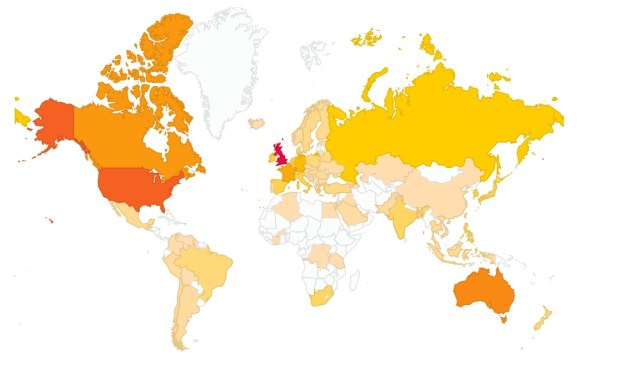
Visitors 2013

The 2013 playlist

  1. The El Train – Hoxton Hall, December
  2. The Shape of Things – Arcola Theatre, December
  3. Henry V – Noel Coward Theatre, November
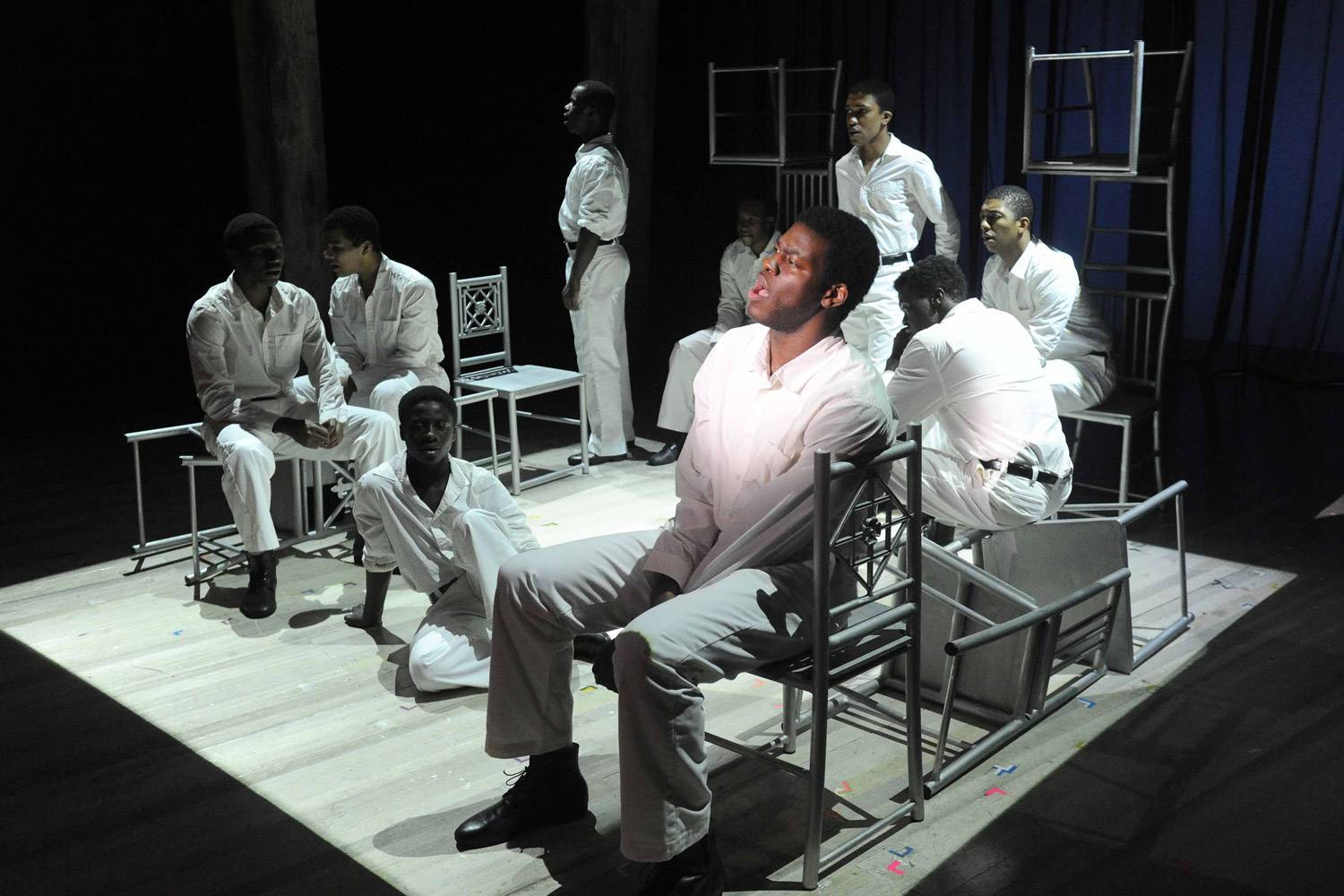
  4. The Scottsboro Boys – Young Vic, November
  5. Passing By – Tristan Bates Theatre, November
  6. Mojo – Harold Pinter Theatre, October
  7. The Events – Maria Room @ Young Vic, October
  8. Hamlet de los Andes – The Barbican Pit, October
  9. The Resistible Rise of Arturo Ui – Duchess Theatre, September
  10. Edward II – National Theatre, September
  11. Fleabag – DryWrite @ Soho Theatre, September
  12. The Secret Agent – Theatre O @ the Young Vic, September
  13. All’s Well That Ends Well – Royal Shakespeare Company, Stratford, August
  14. The Same Deep Water As Me – Donmar Warehouse, August
  15. Jekyll & Hyde – Red Shift & Flipping the Bird @ Maltings Art Centre, July
  16. Where the White Stops – ANTLER @ Battersea Arts Centre, July
  17. Circle Mirror Transformation – Royal Court @ Rose Lipman Community Centre, July
  18. Death in Venice – English National Opera @ Coliseum, June
  19. Mission Drift – The Shed @ National Theatre, June
  20. The Cripple of Inishmaan – Noel Coward Theatre, June
  21. Trash Cuisine – Belarus Free Theatre @ Young Vic, June
  22. Merrily We Roll Along – Harold Pinter Theatre, May
  23. Public Enemy – Young Vic Theatre, May
  24. Orpheus – Little Bulb Theatre @ Battersea Arts Centre, May
  25. Fraulein Julie – Barbican, April
  26. Macbeth – Trafalgar Studios, April
  27. Ubu Roi – Cheek by Jowl @ the Barbican, April
  28. Gibraltar – Arcola Theatre, March
  29. This House – National Theatre, March
  30. Peter and Alice – Noel Coward Theatre, March
  31. Watt – Gate Theatre Dublin @ the Barbican, March
  32. Mydidae – Trafalgar Studios, March
  33. In The Beginning Was The End – dreamthinkspeak @ National Theatre, February
  34. Rhinoceros – Théâtre de la Ville–Paris @ the Barbican, February
  35. Old Times – Harold Pinter Theatre, January
  36. Julius Caesar – Donmar Warehouse, January
  37. The human being’s guide to not being a dick about religion – Matt Thomas at the Canal Cafe Theatre, January
  38. Kiss Me, Kate – The Old Vic, January

Not reviewed (at least not yet)

  1. American Psycho – Almeida Theatre
  2. Richard II – Barbican
  3. Coriolanus – Donmar Warehouse
  4. Othello – Olivier @ National Theatre
  5. Candide – The Swan @ Royal Shakespeare Company
  6. Metamorphosis – Lyric Hammersmith
  7. Matilda: The Musical – Cambridge Theatre
  8. The Hot House – Trafalgar Studios
  9. Seven Brides for Seven Brothers – Wimbledon Theatre
For all the 2013 reviews click here

The power of art: an always timely reminder

The Scottsboro Boys – Young Vic, until 21 December 2013 (Day Seats and Returns only)

One only needs the barest grasp of American history to understand the incendiary effect Kander & Ebb’s The Scottsboro Boys was likely to have; a one sentence description ‘it is a musical about nine black men travelling The Scottsboro Boysthrough a 1930’s Alabamian town’ is enough to give significant pause.

Add in that it would take the form of a musical revue featuring a black minstrel show and a white southern host and one can begin to understand that The Scottsboro Boys is risky proposition, even by the standards of the team that brought Chicago, Cabaret and a musical interpretation of Manuel Puig’s modernist classic, Kiss of the Spider Woman to the stage.

When you have reinvented the musical, as they did with Chicago, and created a rival to Singing in the Rain as the greatest film musical, Cabaret, it is hard to imagine that the last blooming of creativity would be in the same league. This seems particularly true with the output of musical writers; one only needs to look at the careers of Cole Porter, Irving Berlin, Stephen Sondheim and even Andrew Lloyd-Webber to see a marked drop-off in the quality of their output as the years tick by.

However in the blend of tone and content that Kander & Ebb have brought to The Scottsboro Boys, they have managed to create a piece of theatre that, of all their work, comes closest to being seen as great art rather than great entertainment.

Technically it may not have the brilliance of Cabaret and it may not have the sheer enjoyment of a Fosse-choreographed Chicago, but what The Scottsboro Boys does, in a way not dissimilarto London Road, is to blow away the audience’s preconceptions and retains the force of a story that needs to be told being told in the only way that it can be. There is a coherence and understanding to the work, and a clear role, purpose and intent to the interplay of theatre, music and choreography which sits perfectly with characterisation and story.

The depressing thing is that The Scottsboro Boys was nominated for 12 Tony Awards and won none. In the same year The Book of Mormon was nominated for 14 Tony Awards, winning nine. The interesting thing is that both aim to cover very similar ground despite their plots being a world apart. In a not shocking turn of events, it seems that those giving out the awards got it totally wrong.

Both aim to utilise the time-honoured construct of Juvenalian satire to address prejudices in society, and whilst Trey Stone and Matt Parker’s humour, honed after fourteen years of South Park, takes swings at the big topics it often seems to confuse the scatological for the satirical. At times its views are surprisingly conservative, which perhaps is a reflection of the need to sell those expensive tickets on Broadway to out-of-towners coming across from Middle America. After all there are only so many wise-cracking, elitist New York liberals to sell tickets too.

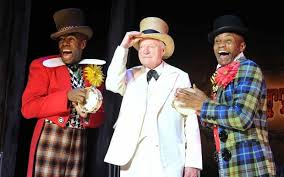
The ringmaster and his 'sidekicks'The Scottsboro Boys, on the other hand, is about as close as one can get to a modern example of this form of satire. It understands implicitly that the purpose of the technique is not to make the audience laugh but to provoke a reaction. Kander & Ebb are well aware of the power of humour to shock and use jokes like verbal hand grenades; the audience often confronted with the sight of two black men forced into playing the archetypal ‘uncle Tom’ roles for their entertainment and internally reconcile the fact that they have laughed at their ‘antics’. This is comedy operating at the very edge of tragedy, and it is all the more powerful for it.

<<Continue to the full review>>

Grieg finds sublimity amidst the grief

The Events – Maria Room @ Young Vic, until 02 November 2013

A rather unusual thing happened to David Grieg whilst he was researching material for The Events (winner of a Fringe First, subject to rave reviews and currently playing at the Young Vic until November); following a feature interview in The Observer he was forced into the position of an issuing a statement via his blog to clarify that his latest work was both not a musical and not about Anders Breivik.

The Events by David Greig  An Actors Touring Company, Young Vic, Brageteatret & Schauspielhaus Wien Co-Production 9 October - 2 November 2013

It is a telling moment in the creation of this subtle and quietly devastating work that one of our leading contemporary playwrights felt the need to publically justify his work; it was a moment that was indicative of the undercurrent of sensationalism that surrounds mass public tragedies and which makes it so difficult to discuss them in anything other than the most binary of terms.

There is nothing in The Events that is suggestive of the Breivik shootings, however the themes are as much about that tragedy as it is about Dunblane, Columbine or Sandy Hook. As a play it is at once singular and all-encompassing; Grieg allows the audience to only see glimpses of the tragedy as the play instead looks at the deeper, more powerful questions that arise in the response to a tragic event.

The play is neither cast nor structured in a traditional way; perhaps rightly assuming that to tell the story through a linear narrative would lead to difficulties in ensuring each viewpoint was treated with equal weight, Grieg has chosen to refract a number of positions through his cast of two, and the community choir.

The result is an audience that remains distanced from the emotional impact of the action; an alienating technique that enables the play to take the form of a Socratic dialogue between the two actors. This is developed further in brief, direct interventions with the community choir, who often resemble a Greek chorus providing commentary on the action.

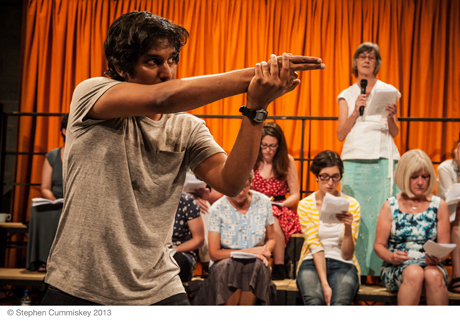
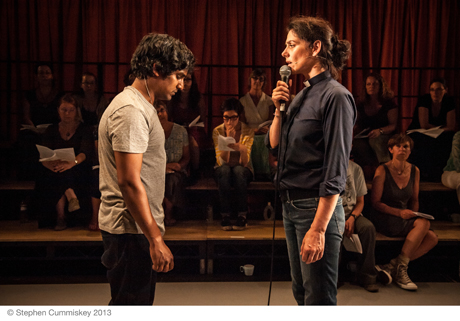
Claire (Neve McIntosh) is ATC / The Events, 2013the community’s priest who set up the choir that was the focal point of the events, and who acts as a mirror to the audience in looking for answers and explanations for the Boy’s actions. Rudi Dharmalingham plays the Boy – always nameless – and all the other characters in the play.

Claire is on a redemptive quest to find understanding in the Boy’s actions in the belief that doing so will liberate her from a perceived survivor’s guilt. The audience follows her through brief, fragmentary scenes, as Claire tries to gain answers that will provide some form of justification for the events rather than them appearing a senseless act of brutality from which survival was little more than pure luck.

However Claire’s crisis of faith (in both the secular and religious world) helps to shape the deeper narrative, which is a dialogue that sets out the precariousness of modern liberalism when it comes under an extreme and sustained attack.  As a lesbian priest with partner and penchant for homemade bread, Claire may be something of a liberal caricature but in her belief and values Claire is reflective of the country that many of the university-educated, metropolitan middle-class assumes Britain to be.

<<Continue to full review>>

Feasting on justifed anger

Trash Cuisine –Belarus Free Theatre @ Young Vic, booking until 15 June

Sitting on the Victoria Line as the tube wound its way towards the end of the line, two women, well-dressed and weighed down with bags, were busy working out their frustrations over the complexity of French employment law when it came to hiring locals to work in their second home. One of the pair wondered whether their 20-year old daughter was old enough to live alone in London.

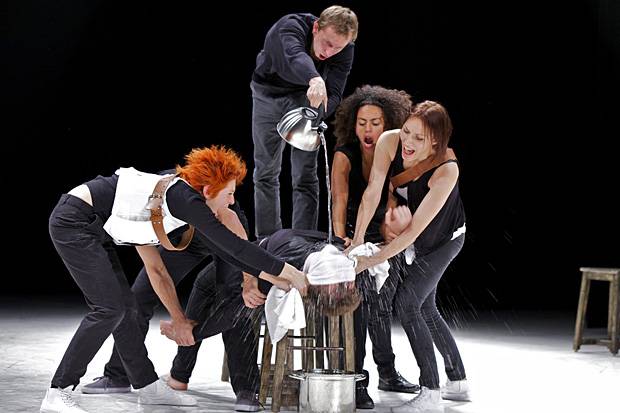
Trash CusineAs I sat and listened, I found it hard not to imagine Liam Holden. Liam Holden? I hadn’t heard of Liam Holden until about two hours earlier. On the 21 June 2002 Liam Holden conviction for murdering a British soldier in Belfast was quashed. In 1989 he had been released from prison having spent 17 years in jail. During his interrogation at Black Mountain Primary School he was waterboarded 6 times, he was stretched up against a wall and beaten for 2 minutes. He had a gun put to his head and told if he didn’t confess he would be shot and have it blamed on the loyalists. By 2002 he had spent almost 70% of his life accused of the murder of Frank Bell, the British paratrooper. Liam Holden was 18 when he was convicted of murder.

I thought to myself that twenty is probably old enough to live alone in London.

Belarus Free Theatre should need no introduction. They are a banned theatre company in Europe’s last dictatorship. Having said that they need no introduction it is likely to be depressing to find out the percentage of people who do not know that Europe still has a functional dictatorship. That a country in Europe still has the death penalty. That theatre companies can still be banned.

Their theatre is raw, angry and political but it avoids polemics and comes alive in its contradictory nature. Trash Cuisine does not have a narrative but it tells many stories. Stories that are intensely local but have a global reach. Stories that are not new but that you have not heard before. Stories that tell of human action but not of humanity.

This could easily sink into the theatre of the righteous. Sub-par Brecht that preaches to the converted and ends with a self-satisfied slap on the back. Belarus Free Theatre has too much at stake and too much talent to allow this to happen. With no state funding they are, in the most literal sense, singing for their supper. With this hunger comes a razor sharp sense of purpose.

They spin steel into their silken storytelling. Scenes unwind into absurdity and farcical slapstick but their messages slice through the levity. Want to hear impressions of different types of death penalty? Well the impression of an electric chair – two minutes of screaming with a ten second break – is an impressive counterpunch.

As the stories unspool one after another like tapes in a broken recorder, each finds a way of piecing together its own meaning. Throughout they mix together a playful sense of the unexpected with a reality that is brutally grounded by the horrors of the language.

Belarus Free TheatreThe story of Nicky Ingram told through the inhabitants of an American nightclub is a beautiful juxtaposition of the everyday lives of American liberals with the final hours of Nicky Ingram, an inmate on death row. Nicky Ingram was one of Clive Stafford-Smith’s very few failures. 300 death row case and a 97% success rate. Nicky Ingram is one of the unlucky ones. For not getting off, and for being born in one of the very few western democracies that routinely kills adults under the auspices of its legal system.

Belarus Free Theatre is never going to win the Audience Choice award. Trash Cuisine is without doubt a harrowing experience but could it be anything less? For the play to succeed it should fill the audience with a sense of outrage that can’t be quelled in the bar after the show. Not every element is entirely successful. Meaning can’t be gleaned from every tableau but as the performances unfold, the company’s idiosyncratic style overwhelms all and beneath the discordant surface an underlying structure reveals itself.

And that structure is built of anger. Anger at the deaths of Vladislav Kovalyov and Dmitry Konovalov, both 26, both executed in Belarus last year, both protesting their innocence. Anger that the death penalty remains in use in 94 countries across the world. Anger that the state-sanctioned violence can lead to a situation like Nyarubuye in Rwanda where 28,000 people were killed by their fellow citizens. Nyarubuye, where it is said only six people survived. That is something everyone can get angry about, and rightly so.

Democracy under the microscope in Ibsen reworking

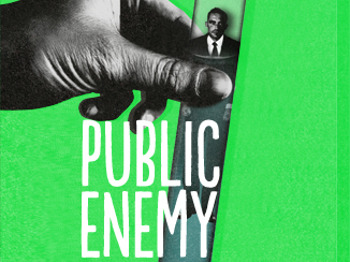
Public Enemy – Young Vic Theatrebooking until 08 June

Continuing from where he left off with Gogol’s The Government Inspector, Richard Jones’ production of a Public Enemy at the Young Vic delves deeper into small town communities and how the introduction of an outside force – be it the arrival of a government official or a report of a contaminated water supply – inexorably leads to the exposure of the venality and hypocrisy of those in positions of responsibility, and those who are able to exercise power.

Running at a brisk 100 minutes and dispensing with the interval in order to allow the play to build towards a frenetic and frenzied conclusion, David Harrower’s updated text reworks Ibsen’s Enemy of the People into a 1970’s Public Enemy logosetting. In this he is aided by a superb set design from Miriam Buether and costumes from Nicky Gillibrand that immediately places the location in a Scandinavia of the 1970s.

Updating Enemy of the People has an advantage of other Ibsen plays in that the central plot device feels as relevant today as when it was written. The tainting of the water supply is something that doesn’t seem so unlikely to a society who has seen the Yangtze River turned the colour of blood and minor earthquakes hit Blackpool following adventures in fracking.

Jones’ Public Enemy reminds us once again of Ibsen’s skill of placing characters in the most exquisite of personal dilemmas – forced into positions that expose their venality and corruption to the world. Each passes under the lens of his microscope, and each ultimately fails to take the action that would potentially redeem them.

<<Continue to full review>>

It’s Beauty and the Beast in Young Vic’s alternative Christmas panto

The Changeling – Young Vic, until 22 December 2012

One of the more interesting aspects of going to watch a lot of theatre is the sight of an idea dusted off to be given a new lease of life and then mainstreamed across London until audiences get tired of it again. The current default
position doing the rounds is that staple motif of directors looking for a fresh angle to breathe life into classic texts; playing the play as a play within a play.

The Changeling

Last year Ian Rickson’s Hamlet was set in the world of 1970’s psychiatry and the action unfolded with references abound to RD Laing, Phyllida Lloyd’s Julius Caesar – currently at the Donmar – is set within the confines of a women’s prison and, not having yet seen it, one would imagine that power structures of the play reflect upon the institutional setting. Joe Hill-Gibbin’s take on The Changeling – Thomas Middleton’s and William Rowley’s Jacobean tragedy – appears to be set within a mental institute with the audience taking on the role of paying guests.

The advantage of doing this is that it liberates the text from the confines of the period in which it was written and it allows space for allusions and references that would not otherwise be possible. The criticism is equally obvious – directorial authority runs roughshod over the intentions of the playwright and their director’s decision-making becomes the critical factor in the production.

This is less of a problem for The Changeling – a play where the plot is so bizarre and bloody that it is hard to understand how it could ever be played with serious intent, seemingly more suited to the plays of Le Theatre du Grand-Guignol. Yet there is an enduring popularity to Jacobean tragedy that seems to be shared by mass audiences and critics alike. The revival of The Changeling has been broadly welcomed, whilst Cheek by Jowl’s equally modern take on ‘Tis Pity She’s A Whore was a critical success and tickets for Punchdrunk’s unique, if fantastically over-hyped, production of The Duchess of Malfi in an abandoned Docklands office block were like gold-dust.

<<Continue to full review>>